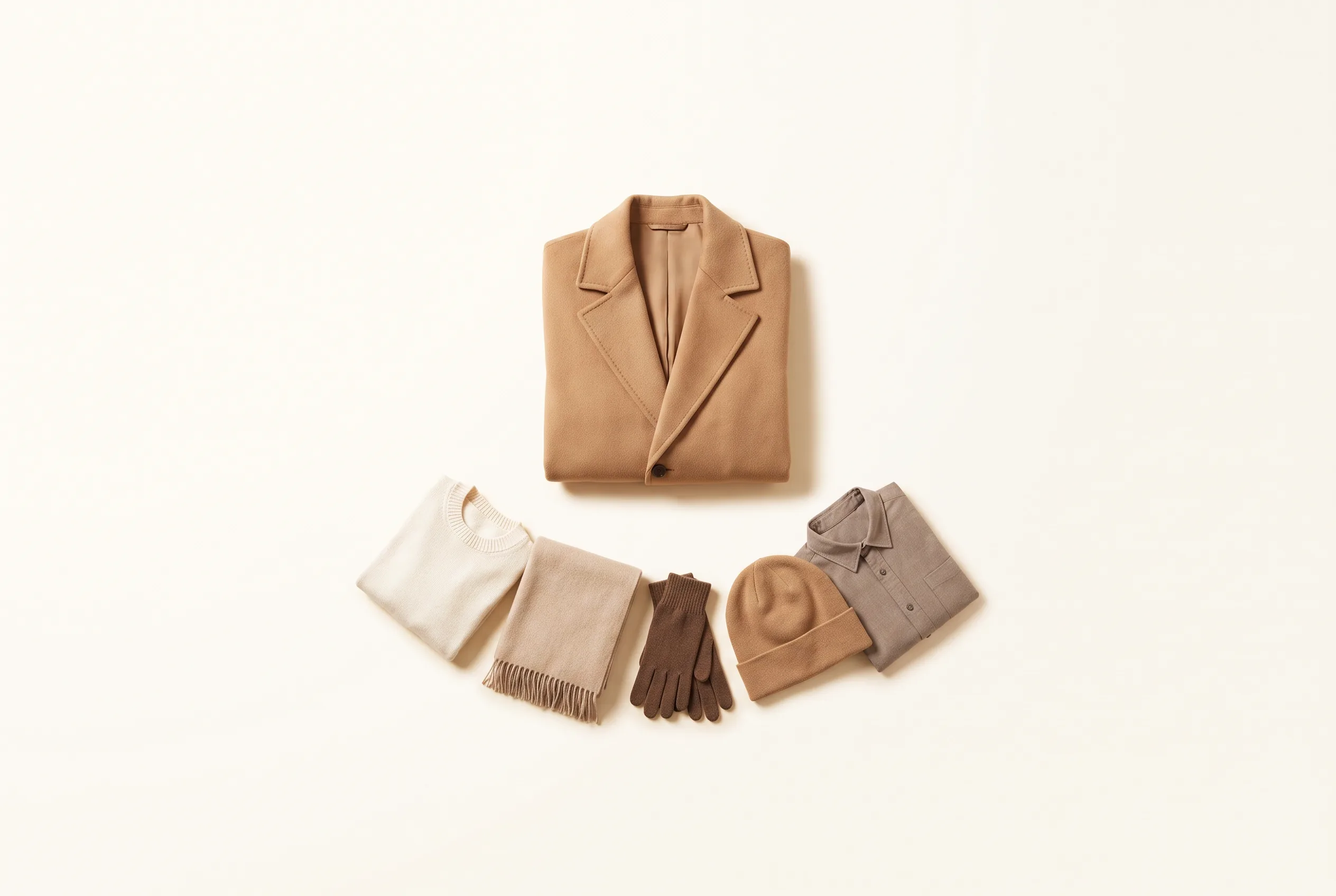
A good coat is the closest thing a wardrobe has to a lead actor. It goes on last, it is what the room sees first, and it can carry a weak scene. Which is why it deserves better than the single role most coats get — thrown over whatever happened underneath, always the same way, until it reads as a uniform rather than a choice.
Take the camel coat, because almost every closet has one or its cousin: a mid-length wool coat in a warm neutral. Here is a working week for it — five ways that are genuinely different, not five photographs of the same outfit in different rooms.
Monday: over the knit, tonal. Cream roll-neck, taupe trousers, the coat open. Everything within two shades of everything else. Tonal dressing does the work that logos try to do — it looks deliberate from across the street — and it asks for nothing except that the pieces be clean and the colors be friendly. This is the coat's easiest outfit, and the one that teaches you its true posture.
Tuesday: against denim, collar up. Straight-leg jeans, white shirt or tee, white sneakers. The coat's formality does something quietly interesting when the rest of the outfit refuses to match it — the tension makes both halves look chosen. If the coat has a collar that stands, let it. This is the version to wear when the day is ordinary and you would rather not be.
Wednesday: closed, belted if it belts. The coat as the outfit. Whatever is underneath barely matters — dark trousers, fine knit, done. Closing a coat changes its species; it stops being outerwear and becomes a silhouette. On days when there is no time to compose anything, this is composition by subtraction.
Thursday: over softness. A knit dress, or the loosest trousers you own, and the finest layer under them. The coat's structure against everything unstructured — this is the pairing stylists reach for when they want ease to look intentional instead of accidental. Shoes decide the register: boots make it evening-ready, trainers keep it Sunday.
Friday: on the shoulders, not in the sleeves. The old editor's trick, and it still works, because it changes the coat's job from warmth to punctuation. Worn this way over something simple and dark, the coat becomes the one gesture in an otherwise quiet outfit. It is a small theatrical act. Use it on the day that has an evening attached.
A note on care, since a coat doing five days of work deserves it: brush the shoulders once a week, hang it on a shaped hanger with room to breathe, and give it one rest day between wears when you can — wool recovers its shape in the closet, not on your back. A coat treated this way holds its line for a decade, which is the quiet arithmetic behind everything above.
Five days, one garment, no repetition that anyone would clock. The formula underneath is portable to almost any strong piece: change the temperature (tonal, then contrasting), change the state (open, then closed), change the grammar (structured over soft, worn as gesture). Any coat that can do three of those five is earning its hanger; a coat that can do all five is the reason cost per wear was invented.
The catch, of course, is remembering all this at 7:40 in the morning with a train to catch. Formulas live best written down — or held by something that knows your closet and hands you Thursday's version on Thursday. That is the job era. is being built to do, and the waitlist is where it begins.